


 Scan and Follow Us


ACEF Vice Chairman Tu Ruihe Attends COP31 Indonesia Pavilion Dialogue and China Pakistan Bilateral Exchange
Sharing China’s Practices in Energy Transition and Green Development
Antalya, Türkiye, November 10, 2026 — During the 31st Conference of the Parties to the United Nations Framework Convention on Climate Change (COP31), the All-China Environment Federation (ACEF) actively coordinated resources from both China and abroad and participated in a series of high-level thematic side events and bilateral exchanges. ACEF showcased China’s innovative practices in energy transition, climate adaptation, and the circular economy, while sharing China’s experience and practical approaches to green and low-carbon development with partners from Türkiye and Belt and Road partner countries. Through these efforts, ACEF contributed Chinese insights and solutions to international climate cooperation and green development, while responding to COP31’s emphasis on “action” and “implementation.”
Invited to Attend the Indonesia Pavilion Dialogue Session nd Share China’s Experience in Renewable Energy Development
On the morning of November 10, Tu Ruihe, Vice Chairman of the All-China Environment Federation (ACEF) and Director of the Belt and Road Eco-Industry Cooperation Working Committee, was invited to attend the Indonesia Pavilion’s thematic dialogue, “Powering Indonesia’s Future: Scaling Clean Power for the Next Wave of Growth”.
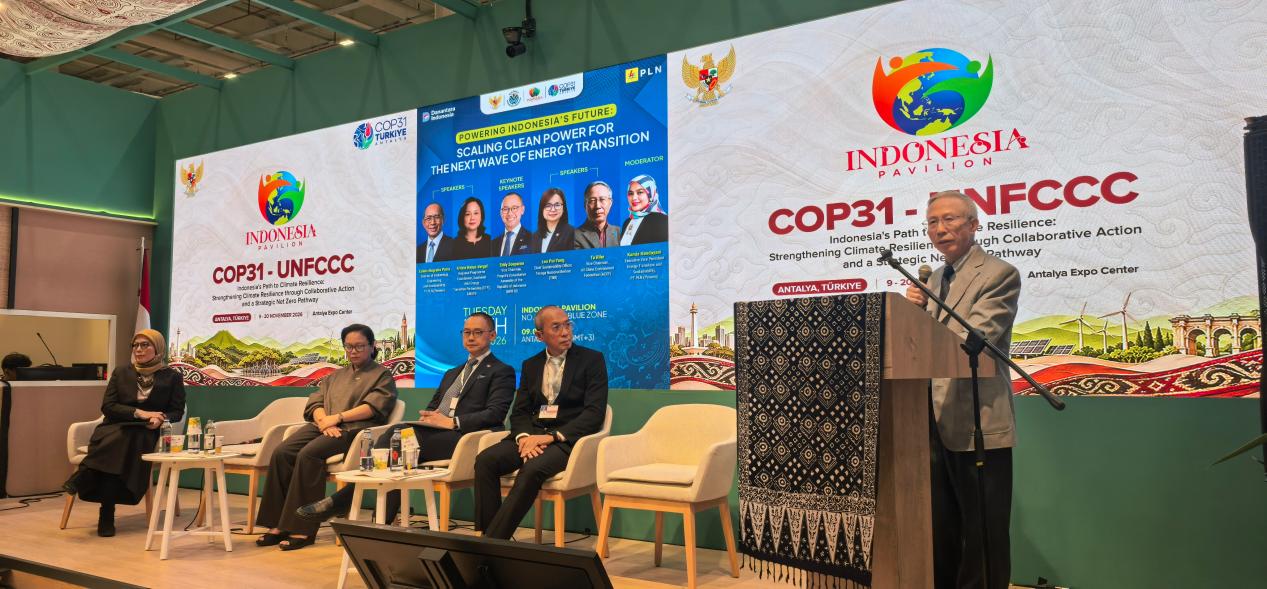
Tu Ruihe Attends and Delivers Remarks at the COP31 Indonesia Pavilion Event
The dialogue focused on the pathways and challenges involved in expanding clean electricity supply as Indonesia advances its transition towards net-zero emissions. Indonesia’s state-owned electricity utility, PT PLN (Persero), is pursuing a target of developing up to 100 GW of solar photovoltaic capacity, alongside the deployment of battery energy storage systems, to meet the growing electricity demand driven by the expansion of data centers, downstream industries, and electrification. Discussions covered six interconnected areas: national policy and regulatory frameworks; PLN’s strategy for scaling up solar PV and energy storage; project preparation and implementation capacity; grid flexibility and ancillary services; international experience in integrating large-scale renewable energy into power grids; and financing and risk-mitigation mechanisms.
In his remarks, Tu Ruihe noted that China’s large-scale renewable energy development began after 2000, driven by a sharp increase in electricity demand amid rapid economic growth. Over the past three decades, China’s renewable energy development strategy has remained closely aligned with its national conditions and the needs of socioeconomic development, energy security, air pollution control, and global climate action.
He outlined three key stages in China’s renewable energy development roadmap: first, the initial phase of pilot projects, decentralized development, and joint ventures and partnerships; second, the establishment of a legal and institutional framework, marked by the adoption of the Renewable Energy Law of the People’s Republic of China in 2005; and third, the integration of medium- and long-term renewable energy development plans into China’s Five-Year Plan framework to ensure their effective implementation.
China has embarked on the implementation of its 15th Five-Year Plan (2026–2030), which sets the target of having wind and solar power account for more than 50% of the country’s total installed power generation capacity by 2030.
Tu Ruihe highlighted three key aspects of China’s experience in renewable energy development. First, China has established a comprehensive and robust industrial and supply chain for its wind and solar PV sectors, providing strong support for large-scale industrial development and facilitating the transition from subsidy-driven growth to market-driven development.
Second, over the past decade, the global cost of wind turbines has fallen by approximately 60%, while the cost of solar PV modules and systems has declined by around 90%, significantly improving the economic viability and market competitiveness of renewable energy.
Third, by leveraging smart grids and digital technologies, China has developed two representative types of power distribution and transmission solutions. The first combines distributed solar PV, distributed wind power, off-grid energy storage, and smart microgrids to provide flexible and reliable energy solutions for remote areas. The second employs ultra-high-voltage (UHV) transmission technologies operating at 750 kV to 1,100 kV to transmit electricity over distances of up to 3,000 kilometers, supporting major metropolitan areas, heavy industrial parks, and data centers located far from power generation bases.
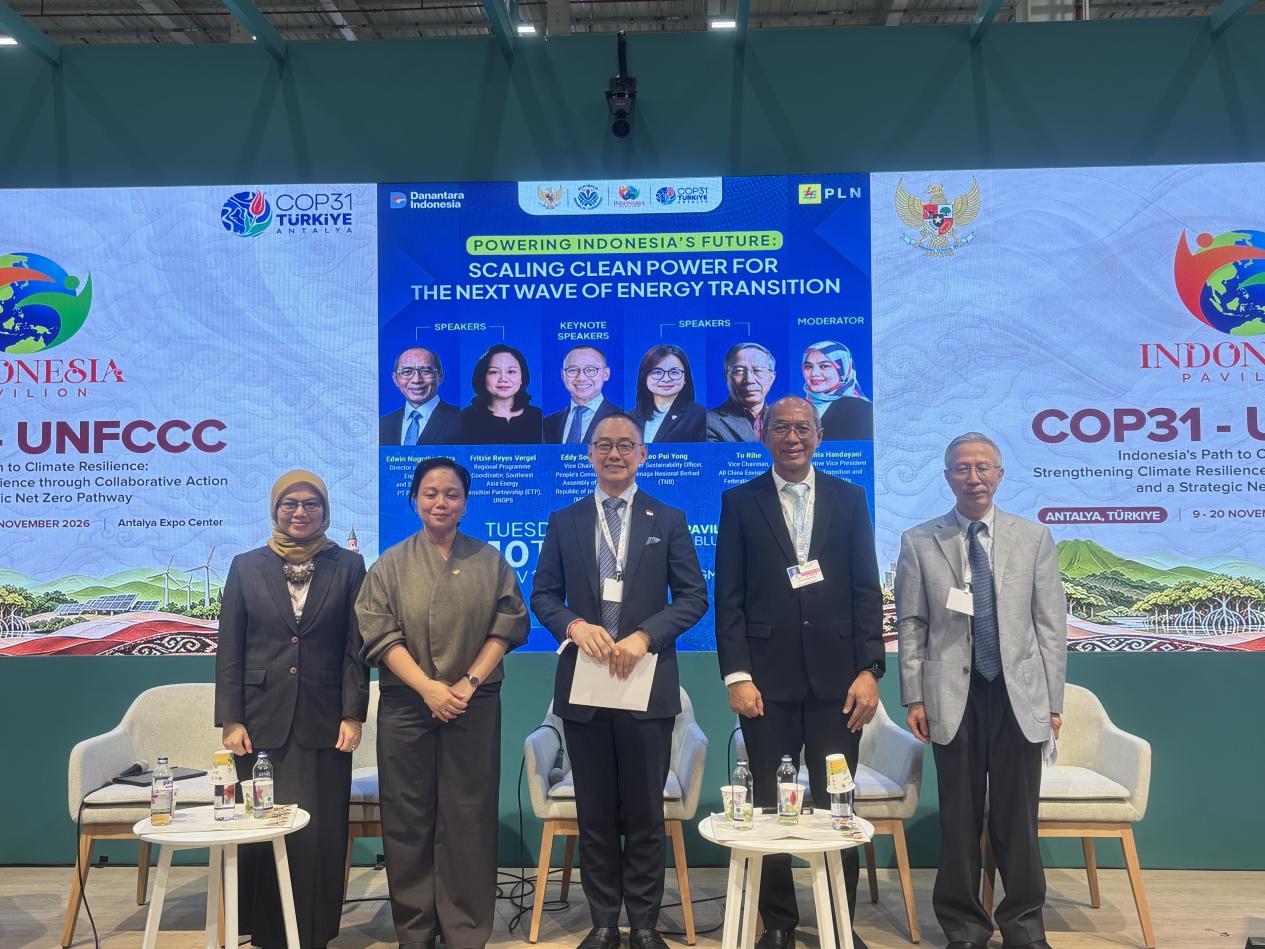
Group Photo of Guests Attending the Thematic Dialogue at the Indonesia Pavilion
Tu Ruihe emphasized that these experiences could offer valuable insights for Indonesia. He welcomed partners from across Indonesia to visit China and gain first-hand insights into China's renewable energy technologies and project experience, and expressed his hope that both sides would work together to explore integrated and cost-effective solutions tailored to Indonesia's development needs, further advancing practical cooperation between China and Indonesia in the field of green energy.
Attend China–Pakistan Bilateral Talks to Discuss Climate Adaptation and Green Cooperation
That afternoon, Tu Ruihe, Vice Chairman of ACEF, led an ACEF delegation to attend a China–Pakistan bilateral meeting at the Pakistan Pavilion upon invitation. Pakistani representatives included Ameer Mohyuddin, Additional Secretary of the Ministry of Climate Change and Environmental Coordination, and Nazia Zaib, Joint Secretary.
The two sides held in-depth discussions on climate adaptation, sustainable development, low-carbon transition, nature-based solutions and ecosystem protection, green finance, technology exchange, and capacity building. They also exchanged views on further deepening practical cooperation between China and Pakistan in addressing climate change.
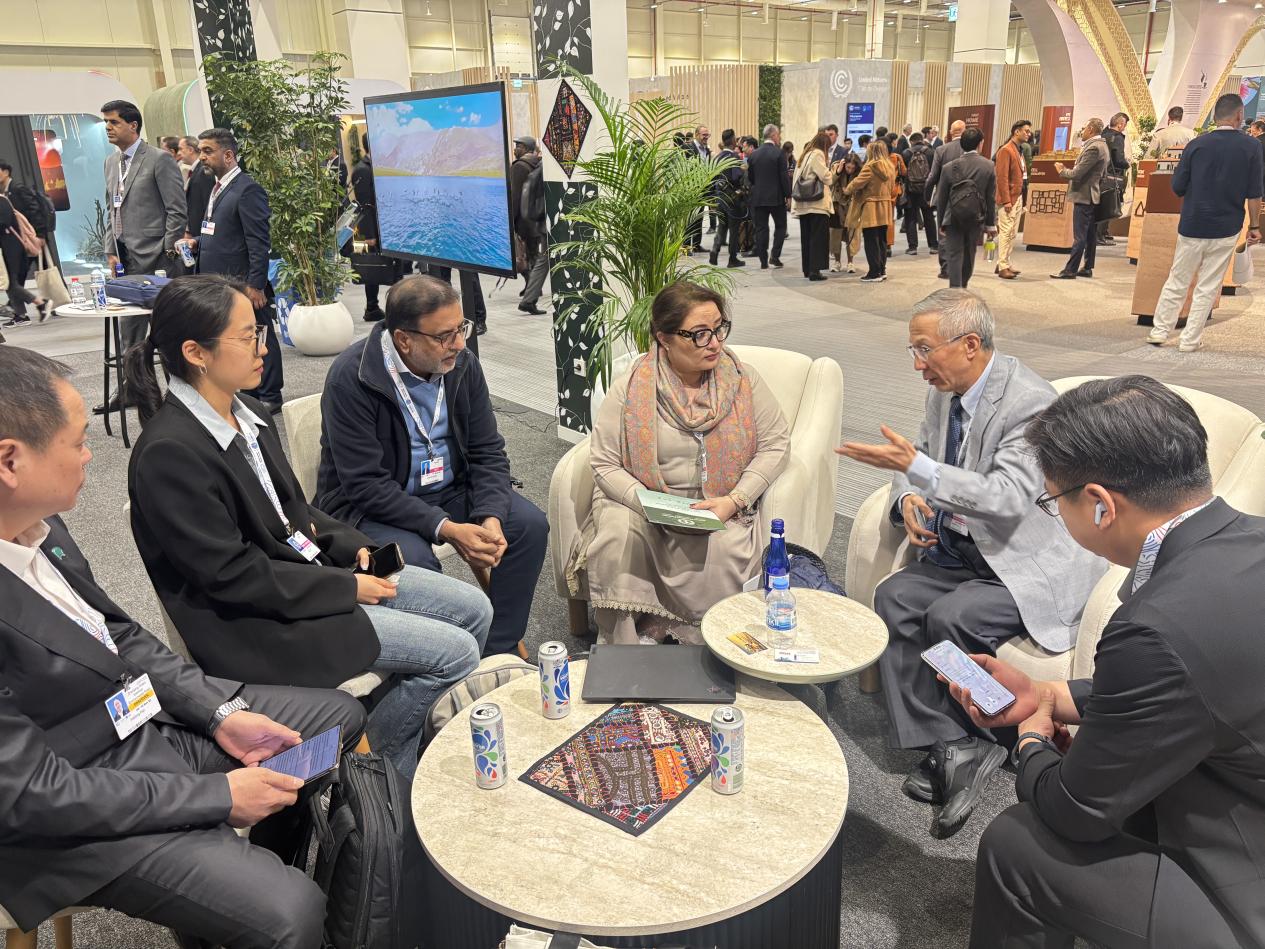
Scene of the Discussion
Advancing Multistakeholder Climate Action through a Series of Initiatives at COP31
In addition to its key activities on November 10, the Belt and Road Eco-Industry Cooperation Working Committee of the All-China Environment Federation (ACEF) will continue to advance a series of practical initiatives during COP31, bringing together diverse stakeholders and deepening international cooperation on climate action.
On the morning of November 12, the Working Committee will host a case-sharing session titled “Multistakeholder Climate Mitigation Strategies and Actions” at UN Press Conference Room 2 in the Blue Zone. The session will feature the announcement of selected COP31 action cases and the shortlist for the Recommended Catalogue of Technologies and Products for Ecological and Environmental Governance under the Belt and Road Initiative. Representatives of shortlisted enterprises, including Kingfa Sci. & Tech., Changsheng Group, Jiangsu Taiyuan Environmental Technology, and JinkoSolar, will be invited to share their practical experience in green and low-carbon development.
On November 13, ACEF will hold three international cooperation signing ceremonies in the Green Zone. It will hold meetings and sign Memoranda of Understanding (MoUs) with the Ankara Chamber of Industry (ASO), Türkiye’s Sistem Global, and GüR?? Group, further expanding the network for China–Türkiye cooperation in green industries.
In addition, ACEF will participate in a series of high-level events, including the thematic session “Technology and Prospects for Renewable Energy Development in the Global South,” the “Bridging the Gaps” side event at the Türkiye Pavilion, the China–Malaysia bilateral closed-door meeting for energy professionals, and the “Building a Green Silk Road Together” event at the China Pavilion. Through these engagements, ACEF will showcase China’s practical experience and solutions in green and low-carbon development, while promoting dialogue, mutual learning, and practical cooperation among stakeholders.