


 Scan and Follow Us


Chemical Oxdiation and Soil Washing Combined Remediation Technology for Contaminated soil
Applicating Company
China National Chemical Engineering Heavy-mechanized Corporation Ltd.
Technology Name
Chemical Oxdiation and Soil Washing Combined Remediation Technology for Contaminated soil
Technical principle
① Mechanism of Chemical Oxdiation
Chemical oxidation is the addition of chemical oxidizer to contaminated soil and relies on the oxidation ability of chemical oxidizer to decompose and destroy the structure of pollutants. It is a technology that degrade pollutants or transform into low toxic and low mobility substances. With low pollutant redox potential and the characteristics of strong reductivity, add oxidants to the polluted soil, and use oxidizer with pollutants, so that to decompose or transform into low toxic or harmless substances, so as to achieve the removal of pollutants. Taking cyanide as an example, persulfate is selected as an oxidant, and the mechanism is as follows:
S2O82-+Fe2+→Fe3++·SO4-+SO42-
·SO4-+OH-→·OH+SO42-
CN-+2·OH+H2O→CO2+NH3+OH-
The reaction process is: Persulfate is activated into a sulfate radical under iron ions, which is converted into a more oxidizing hydroxyl radical under alkaline conditions, and cyanide is decomposed under the nucleophilic attack of the hydroxyl radical and converted into carbon dioxide and ammonia.
② Mechanism of Soil Washing
Using the characteristics of high pollutant solubility, the contaminated soil is dissolved with water as a solvent, and the water is infiltrated through the soil and collected and treated, so as to remove the pollutants in the soil.
③ Mechanism of Combined Remediation
For lightly contaminated soil with low initial contaminant concentrations, First, the vast majority of the pollutants in the soil were decomposed by the high removal rate of chemical oxidation, and then the soil lavage technology was used to further remove the pollutants in the oxidized soil technology, At the same time, make up for the uneven mixing of oxidation repair technology to ensure the uniformity and stability of the pollutant removal effect after washing.
Scope of application
The technique is suitable for the treatment of cyanide and organic pollutants, including fluoride, volatile organic compounds such as dichloroethylene (DCE), trichloroethylene (TCE), tetrachloroethylene (PCE), benzene products such as benzene, toluene, ethylene and xylene (BTEX), semi-volatile organic chemicals (such as pesticides, polycyclic aromatic hydrocarbons and PCBs), and the treatment of compounds containing unsaturated carbon bonds is very efficient and conducive to bioremediation. It also be used to deal with deep heavy metal pollution above the groundwater level, which is most suitable for porous and easily permeable soil, and is best used for sand or gravel soil and deposited soil. Generally speaking, the soil with penetration coefficient greater than 10-3 cm/s has the best treatment effect.
Process flow and description
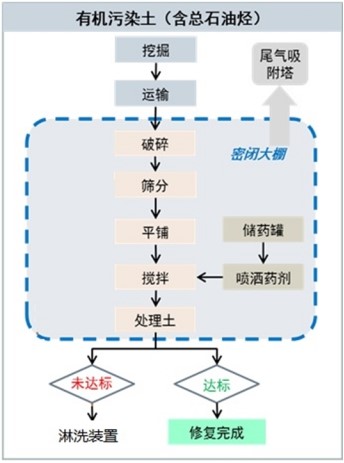
In the soil chemical oxidation restoration engineering, the sieve crushing bucket is first used to filter the contaminated soil, and the debris is removed. At the same time, the contaminated soil is broken, reduce the soil size, the soil mixing bucket grasp the soil from high ground, the operator uses high pressure injection nozzle to spray the soil to achieve full mixing. Each unit can be screened into 60~80 tons of broken contaminated soil per hour, and the added proportion of agents shall be adjusted according to the on-site construction self-inspection results.The contaminated soil that does not meet the standard will be transferred to the soil washing unit for further disposal.
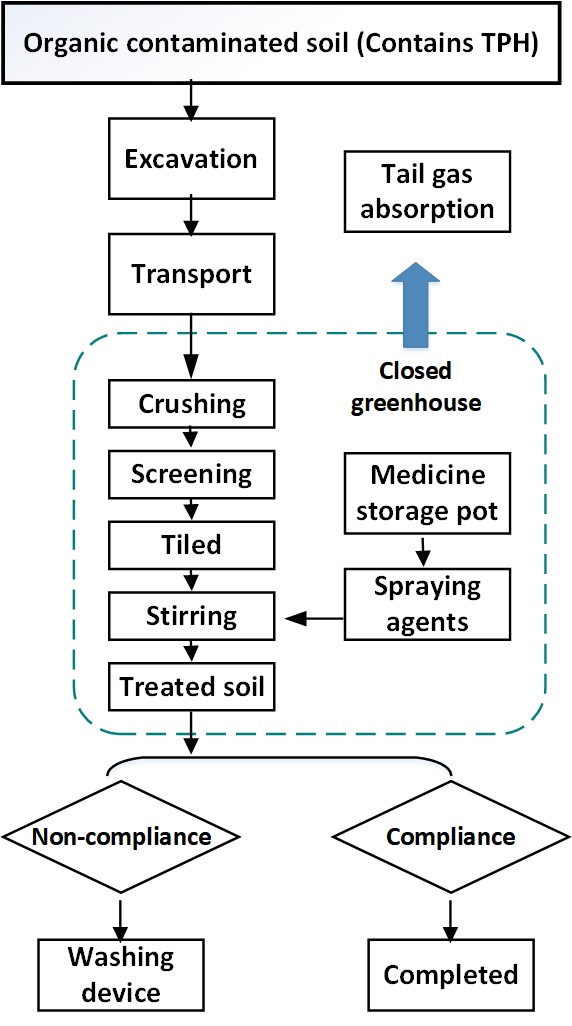
Process flow diagram of Chemical Oxidation
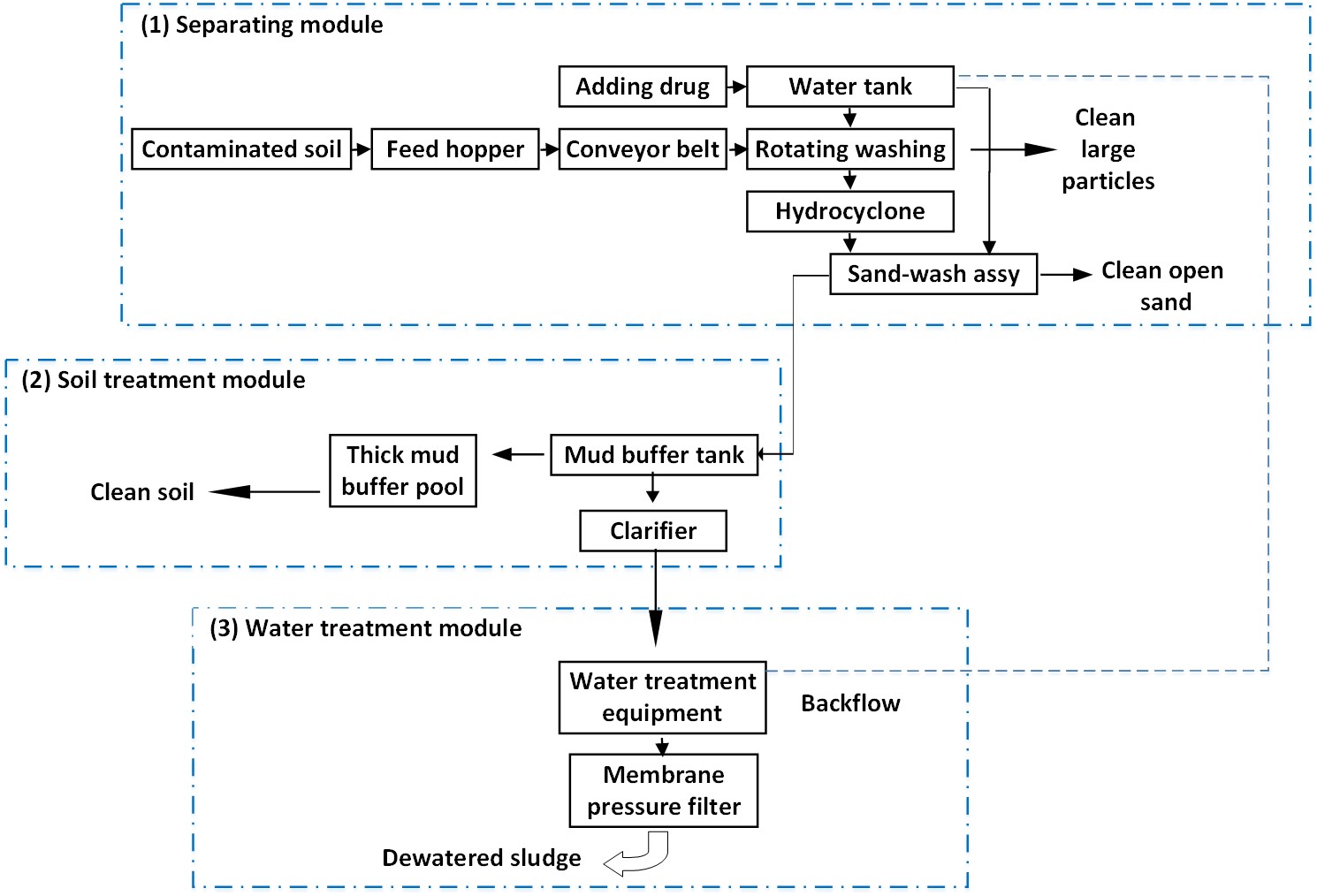
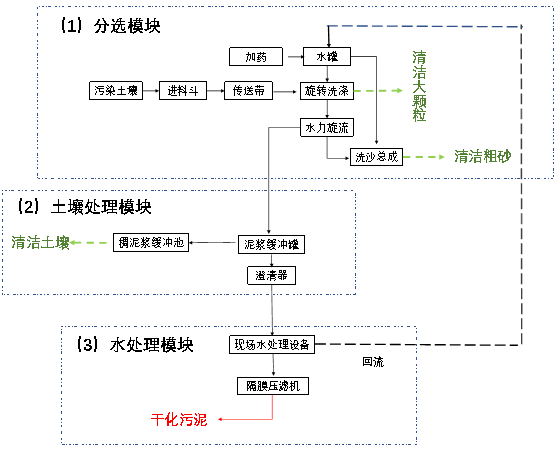
Process flow diagram of Soil Washing
In the actual restoration project, supporting water treatment units can be designed and constructed on site as required.
Promotion prospects
The technology relies on the current national soil remediation and environmental governance, for similar to Tianjin port ruihai company "8 · 12" fire and explosion accident special emergency events, for cyanide, organic pollutants, some heavy metal pollutants and its composite pollution soil, for porous, easy permeable soil effect, also applicable to generally difficult silt powder clay, can achieve convenient, economic, efficient and safe ectopic treatment.Comprehensive treatment price per ton of contaminated soil is lower compared to similar treatment technologies.
The total cyanide content of soil treated with this technology is more than 50% lower than the most stringent national soil environmental standard (risk control value of class I construction land), the immersion value of soluble cyanide in soil is 50% lower than the concentration of surface water (national drinking water source standard), and the one-time acceptance rate of soil reaches 100% after restoration.