


 Scan and Follow Us


Targeted-oriented biological purification technology of volatile organic compounds (VOCs)
Applicating Company
Nanyang resources and environment (Huizhou) Co., Ltd.
Technology Name
Targeted-oriented biological purification technology of volatile organic compounds (VOCs)
Technical principle
Microbial degradation (biological waste gas treatment) refers to the use of microorganisms to digest and metabolize pollutants in organic waste gas. A new technology that utilizes the growth and reproduction characteristics of microbial strains to absorb organic waste gas as nutrients.
The core of biological treatment of organic waste gas is biofilm. The basic principle is to use microbial breeding technology to form a variety of special microbial strains through cultivation, domestication and enrichment, and then inoculate these microbial strains on the surface of the porous filler to form a biofilm layer. When the exhaust gas containing a variety of volatile organic compounds flows through the packed tower, the pollutants in the exhaust gas are transferred to the biofilm due to diffusion; under suitable environmental conditions, the biofilm grows and reproduces through microbial enzymes. The chemical reaction takes the organic components in the exhaust gas as nutrients and degrades them into carbon dioxide, water and cellular constituents, so as to achieve the purpose of purifying the exhaust gas.
The core technology of this process is the targeted-oriented microbial treatment system, in which the biological inoculum is customized according to parameters such as the type, composition and concentration of volatile organic waste gas (VOCs), providing more targeted and higher degradation treatment efficiency.
In addition to biological inoculants, at the same time, we independently developed a new type of high-efficiency biological deodorization equipment, and pioneered the refined pipeline design of the biological deodorization equipment to guide the gas flow and adsorption according to a certain path.
In terms of fillers, innovations have also been made, and flexible biological fillers are used, which can well overcome the problems of traditional biological fillers while ensuring the degradation efficiency.
Process flow and description
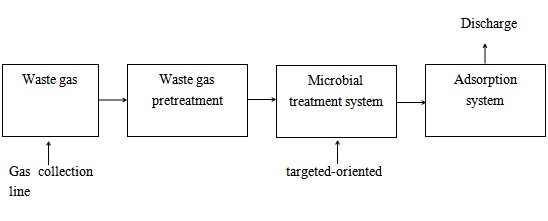
The main process flow of this technology is shown in Figure 1. The exhaust gas is collected and pretreated uniformly to filter out impurities such as suspended solids in the exhaust gas. At the same time, the gas is sterilized, to avoid the secondary microorganism contaminations of subsequent biological treatment unit; according to the type of exhaust gas and components customized microbial system, directional and efficient degradation of toxic and harmful components in the exhaust gas, after adsorption treatment, the gas discarded within the standards.
Promotion prospects
With the rapid economic and social development, the country's emission controlling targets for pollutants are increasing, and the public's awareness of environmental protection and their own health protection has gradually increased. Therefore, the treatment of volatile organic compounds (VOCs) has higher requirements, and needs to be more efficient and unique.
Compared with traditional treatment methods, our technology qualitatively carries out biological purification according to the characteristics of waste gas, and adopts a self-developed microbial treatment system, which has the advantages of low operating cost, efficient and fast treatment, without no secondary pollutions.
Meanwhile, it has a wide range of application scenarios, not only for the treatment of industrial waste gas, but also for the deodorization of waste recycling transfer stations and livestock breeding sites.
We look forward to work with potential collaborators to protect environment and develop the economy.